
The fear of margin feels like fear of a number — the margin call, the forced sale, the morning your broker liquidates without asking. That risk is real, and the danger is in the dose. But if you've ever felt genuine dread over a utilization figure that was, on paper, perfectly survivable, the fear you were feeling wasn't really about the risk. It was about the ungoverned: a number you're carrying but can't see, can't place, and have no rule for. That's a governance problem, not a risk problem — and it's the more fixable of the two.
I run a leveraged book myself, and for a long time I checked the screen the way you'd check a wound. The number wasn't the problem. Not knowing what the number meant, or what I was supposed to do about it, was. This is the reframe that ended that — and why the calmest thing you can do about margin fear is not to borrow less, but to govern what you borrow.
- Margin risk and margin dread are two different problems. Risk is "how much could this cost me." Dread is "I'm carrying a number I can't see or place."
- The dread tracks the absence of a process, not the level of the number. Two people at the identical utilization can feel panic or calm — the difference is governance, not risk.
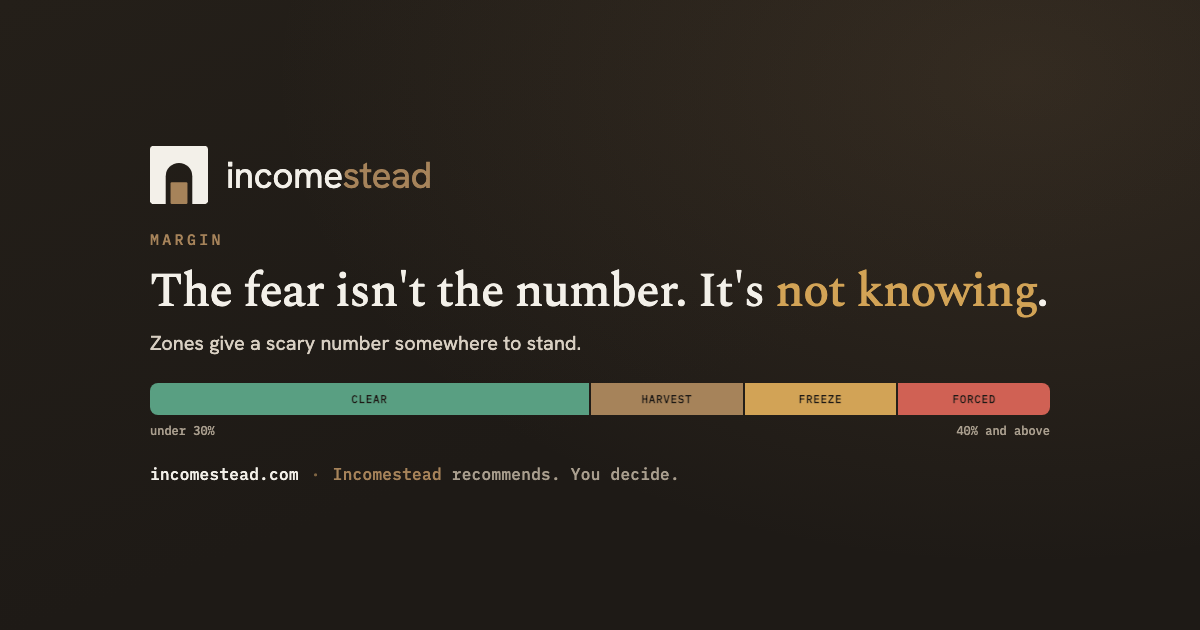
- Zones fix the seeing. Clear / Harvest / Freeze / Forced turn a frightening continuous number into a calm four-state read with a known distance to the edge.
- A cadence and the two-week persistence rule fix the reacting. Short of Forced, one bad reading isn't an emergency; a breach that persists is. That kills the panic-refresh reflex. Forced, at 40% and above, is the one exception: it acts on the first reading.
- Governance doesn't remove the risk. It removes the blindness — and the blindness is what the fear is made of.
What's the difference between margin risk and margin fear?
Margin risk is a property of your balance sheet: how far your assets can fall before your loan forces a sale, and how much a decline is amplified by the leverage. It's measurable, it's bounded, and — as covered in the difference between a governed dose and a reckless one — it's mostly a function of how much you borrow relative to what you hold.
Margin fear is a different animal. It's the felt experience of carrying an exposure you have no instrument for. You know there's a cliff somewhere. You don't know how far away it is, whether you're walking toward it or away from it, or what you'd do if you got close. The nervous system treats "unknown distance to a cliff" exactly like "standing at the edge" — so a perfectly safe number can produce genuine dread, and a dangerous one can produce false calm. The fear is not reading your risk. It's reading your lack of governance.
You're not afraid of 33% utilization. You're afraid that you don't know what 33% means, or what you'd do at 41%.
Why am I so afraid of margin when the number is survivable?
Because a raw utilization figure gives you nothing to hold onto. Your broker shows you a percentage — say 33% — and then leaves you alone with it. Is that fine? Is that close? Should you act today, or is it noise? The screen doesn't say — reading that number as a zone does. So every time you look, you re-run the whole anxious calculation from scratch, and because you never resolve it, you look again. That loop is the dread. It isn't caused by the leverage; it's caused by the absence of a frame that would let a number be finished being worried about.
This is why "just borrow less" is such an unsatisfying answer to margin fear. It treats the risk and ignores the governance. Someone who drops from 33% to 20% with no framework still doesn't know whether 20% is safe, still has no rule for when to act, and still refreshes the screen — they've lowered the risk and kept the dread. The cure for the fear isn't a smaller number. It's a governed one.
How zones turn a scary number into a calm read
The single most calming thing you can do to a continuous, frightening number is give it states. Instead of an open-ended percentage that could always be "too high," margin utilization sorts into four zones, each with a plain meaning and a plain response:
| Zone | Utilization | What it means | The read |
|---|---|---|---|
| Clear | < 30% | Comfortable working room below the 30% ceiling. | Nothing to do. Note it and move on. |
| Harvest | 30% to under 35% | Working, but no longer adding leverage. Direct new cash to the loan. | Watch, don't panic. Hold or trim, don't add. |
| Freeze | 35% to under 40% | Too close. No new risk; start reducing the loan deliberately. | Act with a plan, not in a hurry. |
| Forced | ≥ 40% | Existential. A moderate drawdown from here can trigger liquidation. | Reduce first, everything else second. |
House limits, not a regulatory standard — these bands are deliberately tighter than any broker or bank requirement.
Notice what the zones actually do to the fear. A raw "33%" is an open question. "Harvest — watch, don't add, plenty of room to Forced" is a closed one. Same number, same underlying risk, but now it has a name, a meaning, and a response — so there's nothing left to keep worrying at. The full Clear / Harvest / Freeze / Forced system for using margin as a weekly tool is the instrument that reads the number back to you this way, every week. The 30% edge of Clear is not arbitrary, either — it maps to the benchmark serious lenders and family offices use for safe leverage.
Same number, different dread: a worked example
Two investors each hold a $1.2M portfolio against a $400,000 margin loan. Both are at 33% utilization — identical risk, to the dollar.
Investor A sees "33%" on the broker screen and feels the floor tilt. Is that a lot? It sounds like a lot. He checks again at lunch, again before bed. He has no idea how far 33% is from disaster, so every market wobble feels like the wobble that ends him. His risk is moderate; his dread is total.
Investor B sees the same 33% and reads it as Harvest. She knows the edge that matters — Forced — begins at 40%, which for her book means the loan reaching about $480K or the portfolio falling roughly 17% to around $1.0M while the loan stays put. She knows her rule: stop adding, let new cash pay down the loan, and only act on a breach if it persists. She checks weekly, not hourly. Her risk is identical to A's. Her dread is close to zero.
Nothing separates A from B on the balance sheet. Everything separates them on governance. That gap is the entire distance between dread and calm.
This is the whole argument in one picture. If the fear were really about the risk, A and B would feel the same, because their risk is the same. They don't — so the fear is about something else, and that something else is governance. Which is very good news, because unlike the market, governance is entirely within your control.
How do I stop panic-checking my margin?
You install a rule that tells you when a reading actually matters — so the other readings can be safely ignored. The one we use is the two-week persistence rule: a single scary snapshot is noise, and only a breach that persists across two consecutive weekly snapshots is a signal that warrants acting. Markets are volatile; utilization can spike on a bad Tuesday and settle by Friday. Reacting to every spike is how people sell at the exact wrong moment. Waiting for persistence is how you tell a real trend from a flinch. The rule applies with one deliberate exception — Forced, at 40% and above, acts on the first reading.
The persistence rule is what breaks the refresh loop, because it makes hourly checking pointless by design — there is nothing you're allowed to do with an intra-week number anyway. It also feeds a broader read: in the Incomestead framework, a book sitting near Forced caps your Governance Score, our single measure of how well you're running the whole operation. Margin comes first for a reason — it's the one exposure that can end the game before allocation drift ever gets a vote. The governance layer that sits above strategy exists precisely to enforce that order for you, so you're not re-deciding it, anxiously, every time you look.
The dread audit: run it on your own book this week
Here's how to tell, in five minutes, whether what you feel about your margin is a risk signal or a governance gap. Answer four questions about your own account:
- Do you know your margin utilization right now, as a percentage of what you hold? (Loan ÷ gross securities value — holdings only, cash excluded.)
- Do you know which zone that puts you in — Clear, Harvest, Freeze, or Forced?
- Do you know your distance to Forced — roughly how far your assets could fall, or your loan could rise, before you cross 40%?
- Do you have a cadence and a rule — a set day you check, and a persistence test for when a reading actually warrants acting?
Every "no" is a governance gap the dread is filling. Close the gaps and you'll find the fear had nothing underneath it but the not-knowing.
None of this is a nudge to borrow more, or a claim that governed margin is safe margin in some absolute sense. It isn't. Margin amplifies losses as surely as gains, and the mechanics are unforgiving: your brokerage firm can sell your securities without notice when your equity falls short, and a firm can raise its own "house" maintenance requirements at any time without advance notice — often precisely for securities in large daily price swings, i.e. exactly when markets are worst. Governance won't lower your risk by a single dollar. But it will end the blindness — and once you can see the number, place it, and know your rule for it, you stop being the single point of failure between your book and a forced sale, and the dread has nowhere left to live. I lived both sides of that line myself, on the two Fridays that taught me the difference between the fear and the rule. The fuller case against my own position is published rather than hidden — the best argument that governed margin is still the wrong risk to take.
Do this next
Run the dread audit on your own book this week — and put a zone next to it before you begin. The Margin Zone Checker takes your account value and the amount you have borrowed and returns your zone: the thing you have been carrying as a feeling comes back as one of four words. Questions three and four are still yours, and they are the ones that decide whether the number is a problem or just a number.
Read your zone → — it runs in your browser.
Frequently asked questions
Why am I so afraid of margin?
Usually because you're carrying a number you can't place. A raw utilization percentage tells you nothing about how close you are to trouble or what to do about it, so the fear fills the gap. Give the number a zone (Clear / Harvest / Freeze / Forced), a known distance to the danger line, and a rule for when to act, and most of the dread resolves — because it was never about the number, it was about the not-knowing.
Is it normal to be scared of using margin?
Yes, and the instinct is protective — leverage genuinely raises the stakes. The mistake is treating the fear as a verdict on the risk. The fear tracks how ungoverned your position feels, not how dangerous it actually is. Two investors at the identical utilization can feel panic or calm depending purely on whether they have a process. The healthy response isn't to suppress the fear or to blindly borrow less; it's to build the governance that gives the fear something accurate to read.
What's the difference between margin risk and margin fear?
Risk is a measurable property of your balance sheet: how much a decline is amplified and how far assets can fall before a forced sale. Fear is the emotional experience of holding an exposure you can't see or place. They often move independently — a safe book can feel terrifying without governance, and a dangerous one can feel deceptively calm. This post is about the fear; the dose question is about the risk.
Will borrowing less make the fear go away?
Rarely, on its own. Lowering utilization lowers the risk, but if you still don't know what your new number means, whether it's safe, or when you'd act, you'll keep checking and keep dreading. The fear responds to governance — zones, a cadence, a persistence rule — far more than to the size of the loan. A governed 33% feels calmer than an ungoverned 15%.
How often should I check my margin utilization?
On a set cadence — weekly is enough for most books — not continuously. Intra-week spikes are usually noise, and the two-week persistence rule means a single reading below Forced can't warrant action anyway, so hourly checking buys you anxiety and nothing else. The rule applies with one deliberate exception — Forced, at 40% and above, acts on the first reading. Pick a day, read your zone, apply your rule, and close the laptop.
This is education, not personalized financial, tax, or legal advice. I write as a practitioner who runs a leveraged, income-oriented book, not as a licensed adviser. Margin carries real risk: it amplifies losses as well as gains, a broker can liquidate your positions without contacting you first, and a firm can raise its maintenance requirements at any time, especially in volatile markets. Nothing here is a recommendation about how much you personally should borrow. Consult a qualified professional before acting on anything here.
Incomestead recommends. You decide.