These are the tools I use to govern my own book, rebuilt to run in your browser. Each one lives on the article that explains the thinking behind it, because a number without its reasoning is just a number — you should be able to read why a tool says what it says on the same page it says it.
All six are free and complete. There is no locked half, no email wall in front of the result, and no upgrade prompt standing between you and your own reading. They compute entirely in your browser: the figures you type are never sent to us, and none of them are kept between visits unless you switch that on yourself.
Which tool should I run first?
If you have never written down what your money is for, start with the Investment Charter. Most of the others measure you against your own targets, and without a written target there is nothing to measure against. It takes one sitting.
If you carry a margin loan, start with the Margin Zone Checker instead. Leverage is the one risk that is existential rather than merely untidy: margin requirements can rise without warning, and a broker can liquidate your positions without contacting you first.
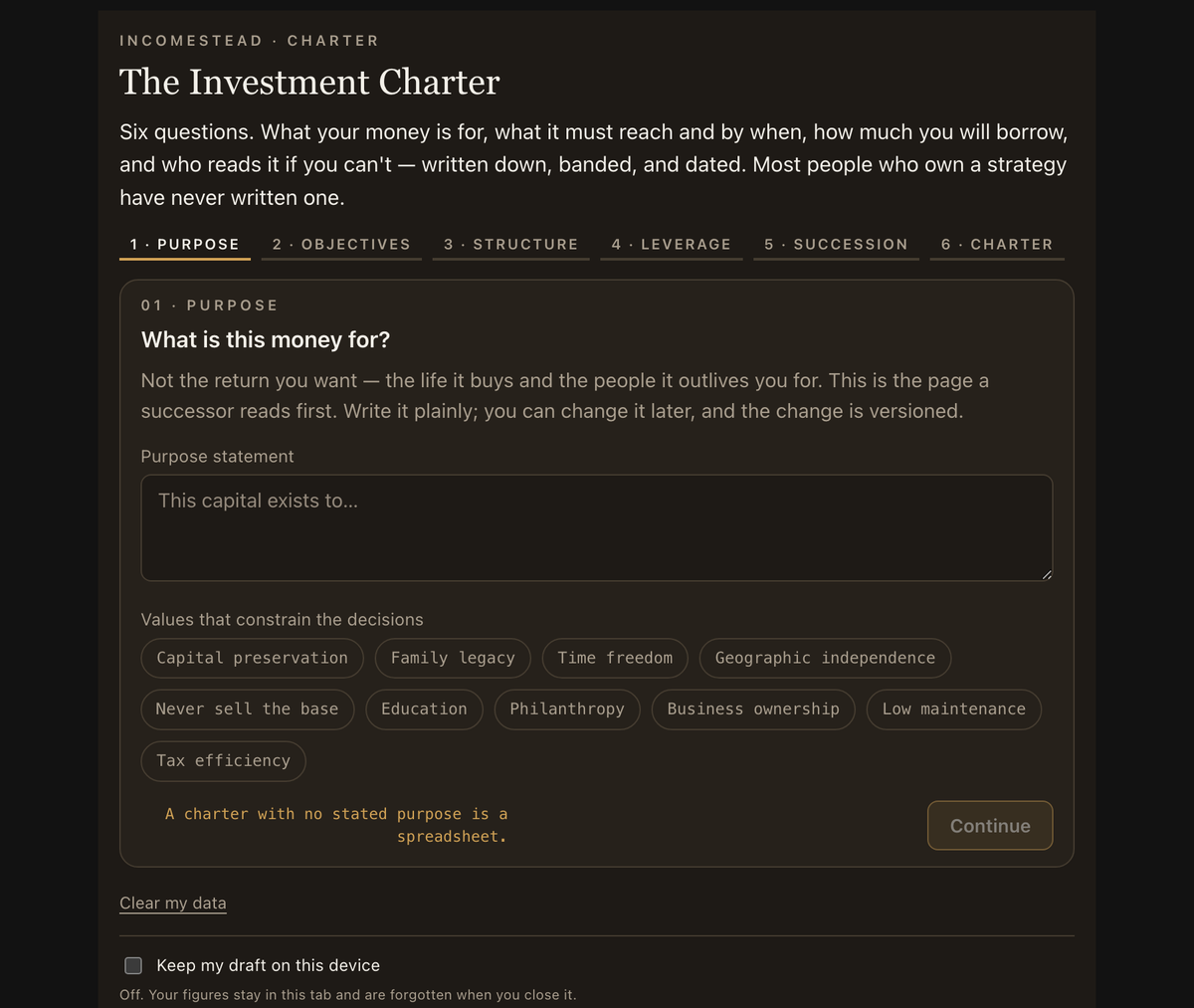
The Investment Charter: write down what the money is for
Write down what your money is for — then have it governed against.
A short, guided document stating your targets, your bands and your rules, written by you rather than filled in from an import. It exports as a PDF and as a machine-readable file — free, no account, yours to keep, amend, and hand to your accountant or attorney. A governing document you cannot take with you fails the one job it exists for.
It is also the key to the rest of the suite: it is what turns “roughly balanced” into something a tool can actually check.
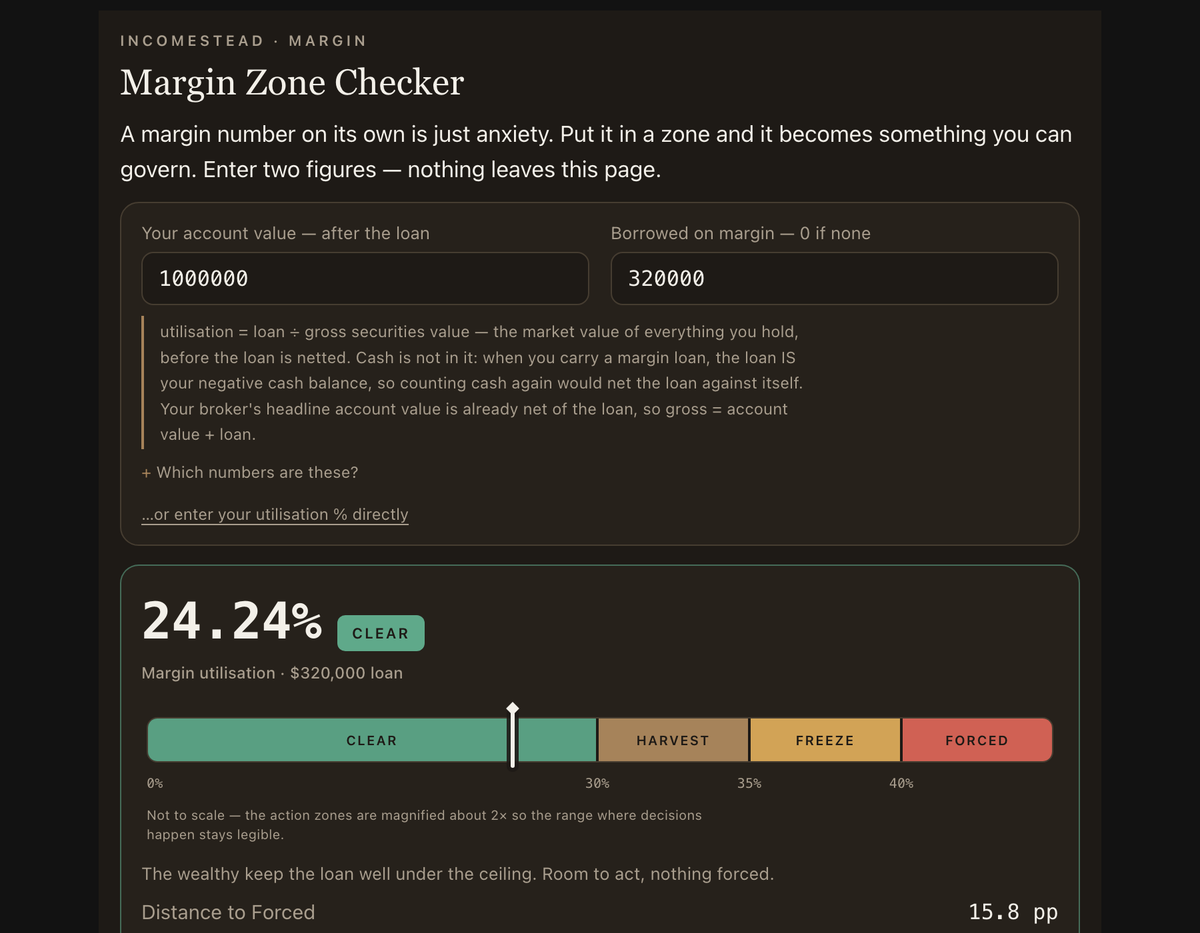
The Margin Zone Checker: a free margin utilisation calculator
Turn a scary continuous number into a calm four-state instrument.
Enter your account value after the loan and the amount you have borrowed on margin, and it places you in one of four zones — Clear, Harvest, Freeze or Forced — and states the rule behind the verdict in full, so you can apply it yourself next week without the tool.
The point is not the percentage. The point is that a continuous number invites bargaining and a named state does not.
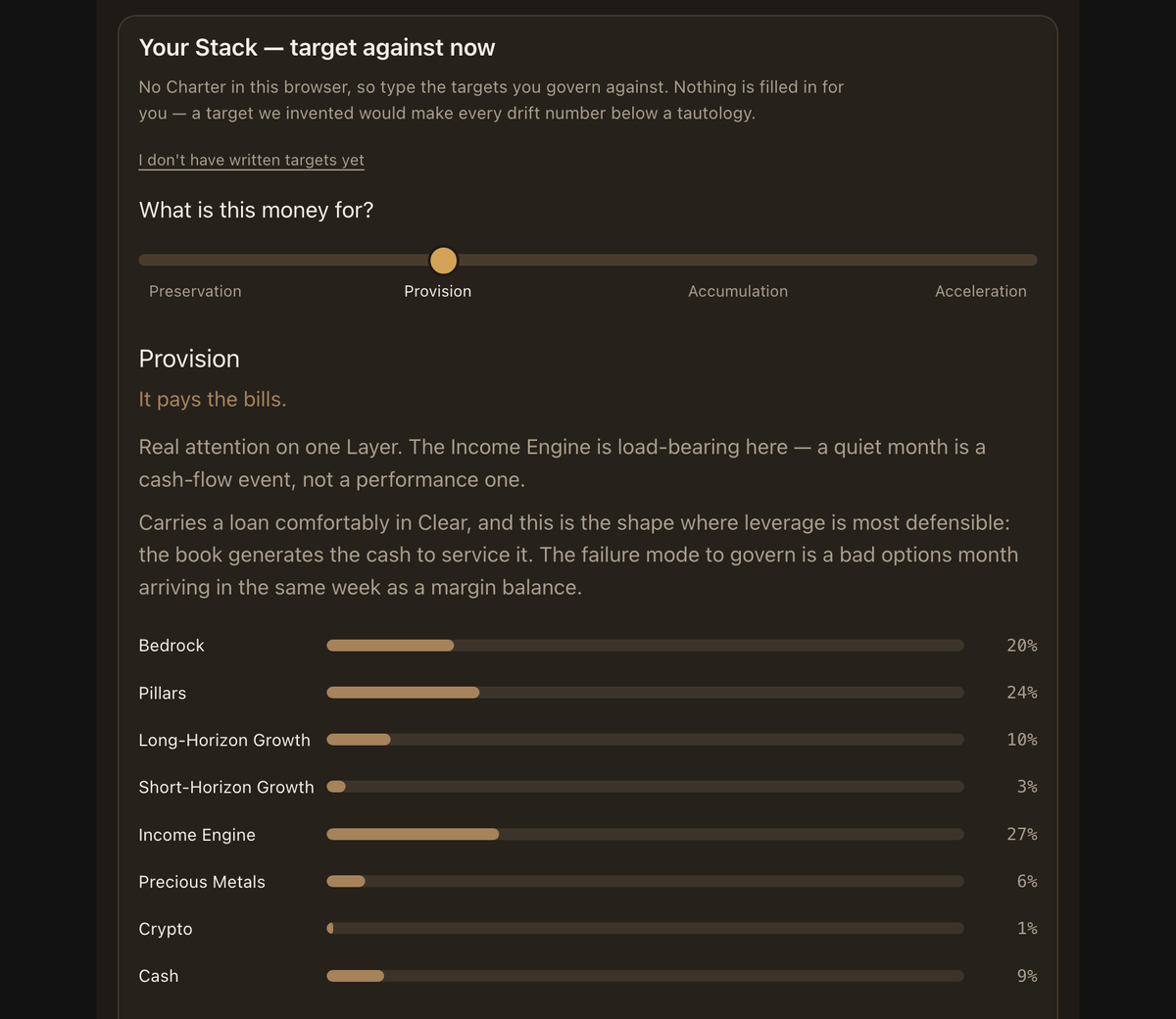
The Allocation Reality Check: see how far your weights have moved
See your real drift against your own targets, in five minutes.
Your actual weights against your written targets, Layer by Layer, with the drift stated plainly and your largest holding flagged if it has grown into a single point of failure of its own. It reads your Charter if you have written one, and tells you honestly what it cannot measure if you have not.
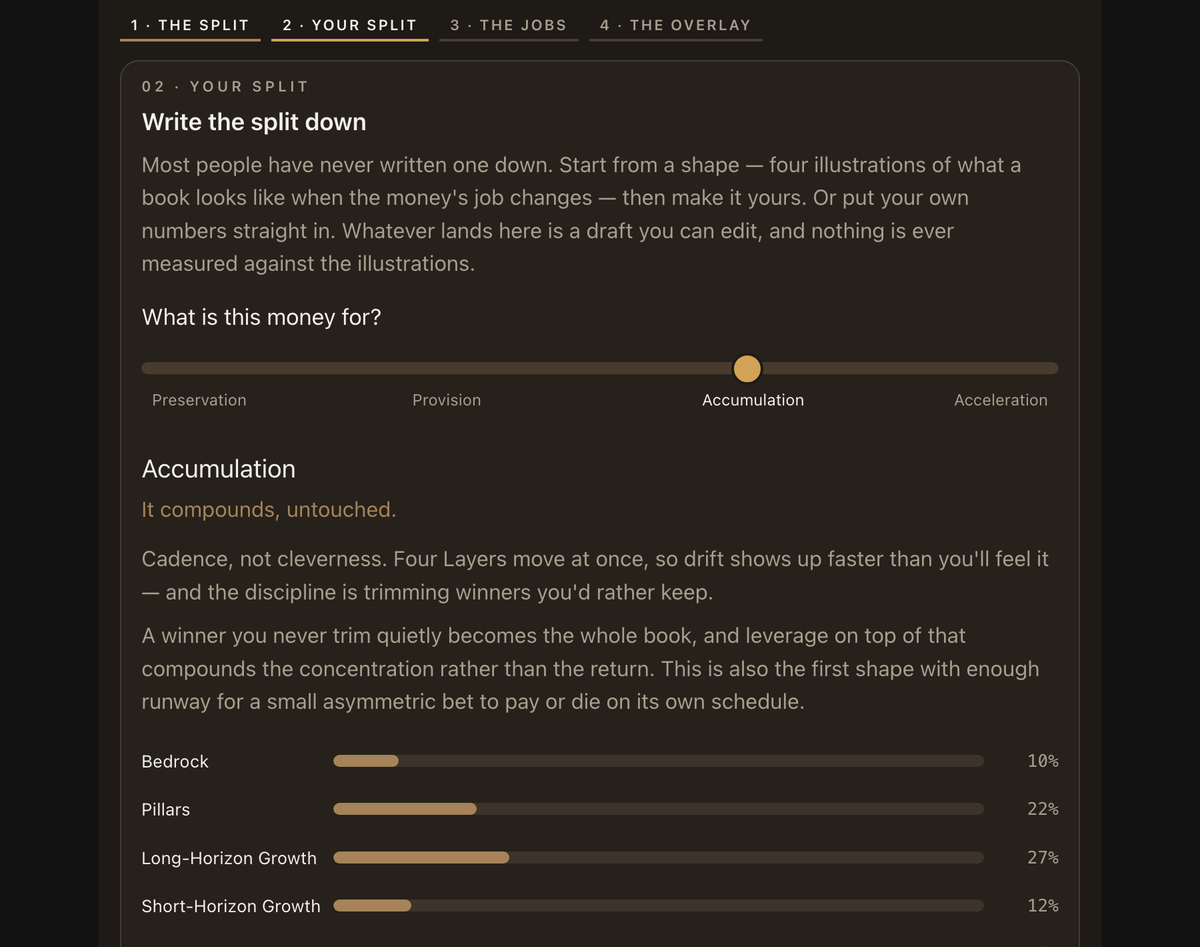
Am I Diversified Enough? The diversification check
Learn the Stack and see where you sit.
Owning more things is not the same as being diversified. This walks the Incomestead Stack and reports how many distinct jobs are actually in play across your holdings — and says on screen that breadth is reported, never scored. A Layer you deliberately sized to nothing is governed; a Layer you never considered is not, and no count can tell those two apart.
Retirement Planner: Drawdown vs. Borrow
The decumulation choice every generic calculator ignores.
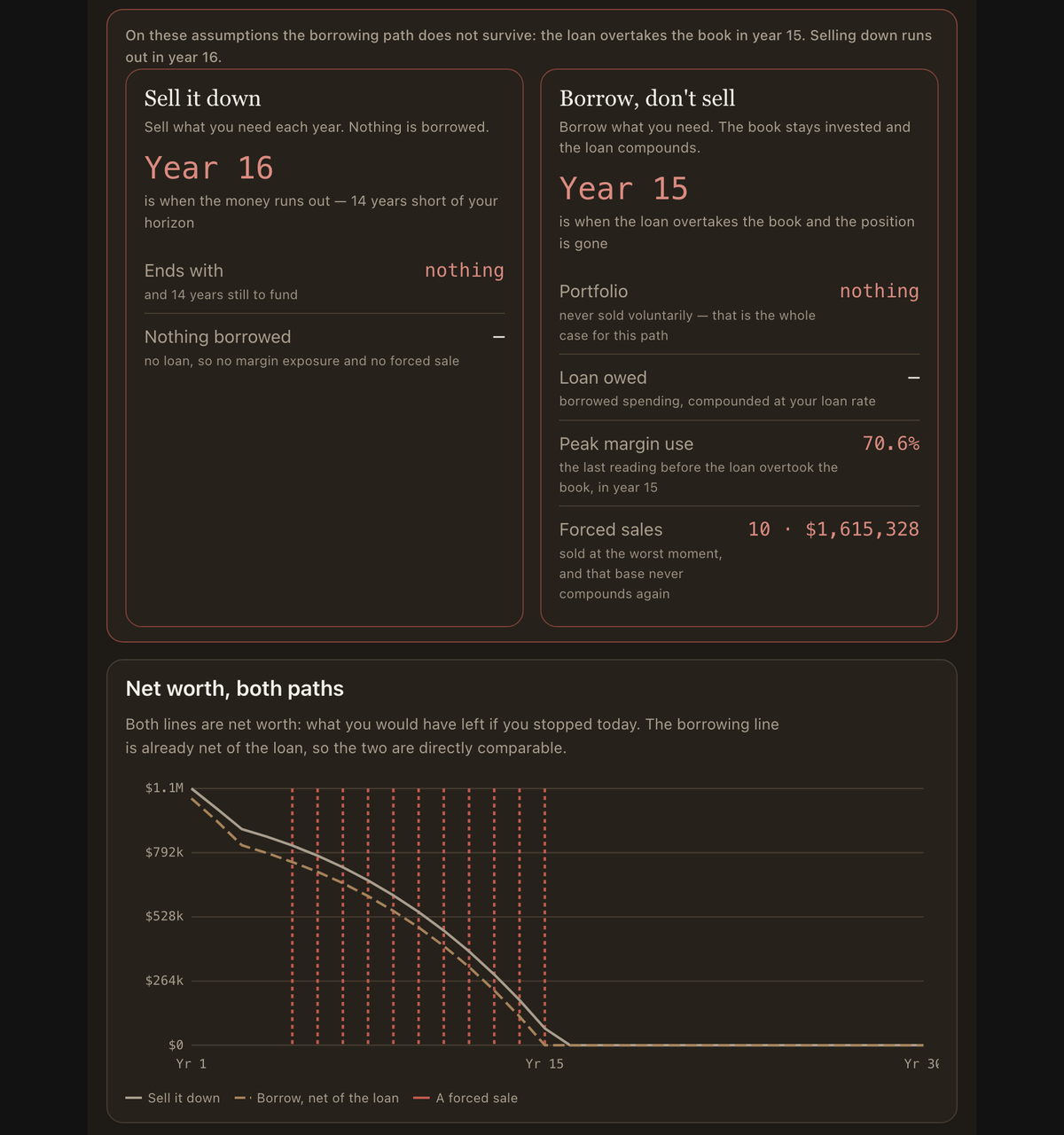
Two paths side by side over a full year-by-year projection: selling assets to fund your life, or borrowing against them. Six labelled assumptions, a stress control, and the worst year of the projection shown on the same zone instrument the Margin Zone Checker uses — because a projected year and a live reading should be measured the same way.
Its limits are stated permanently on screen: no tax, no estate, no state pension.
The Governance Score: one read on how well the book is governed
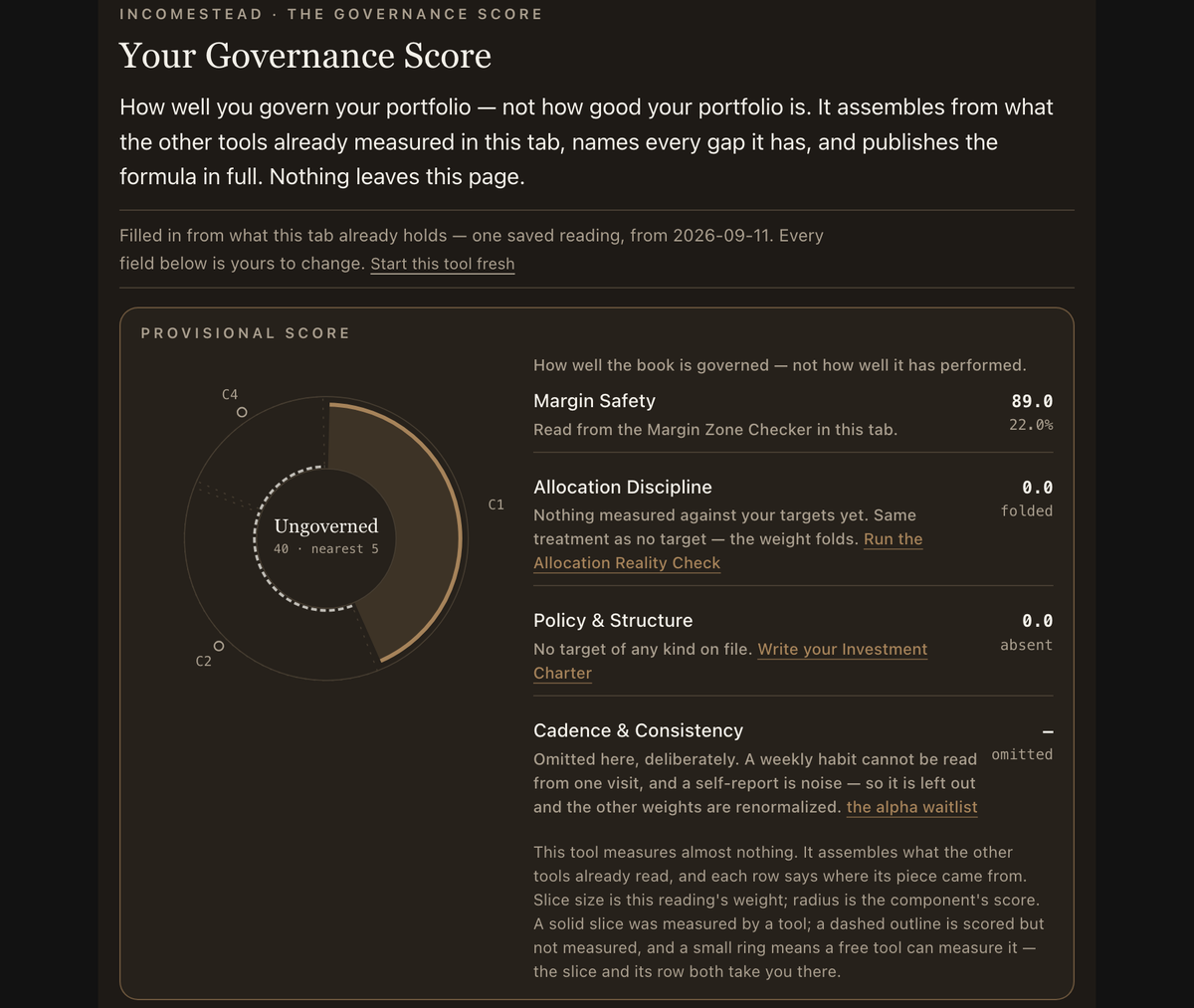
One number for how well the book is governed — assembled from the other tools.
The Score answers “am I running a disciplined process?” and never “are these good investments?” A mediocre portfolio governed well scores higher than a brilliant one left ungoverned, which is the whole point: it rewards the process, not the picks.
It reads as a band — Well-Governed, Governed, Loosely Governed, Ungoverned, or Exposed / At the Edge — and the band is the headline. A number is shown underneath it, deliberately de-emphasised and rounded, because two scores a few points apart are the same conversation. A book one bad week from a forced sale is capped no matter how tidy the allocation looks.
The page publishes its own method in full, read from the same parameter file the tool computes with, so what you see there is the arithmetic that produced your number. Those weights are my judgment rather than a backtested model — the post says so, and says why the reading is still worth having.
How do the tools fit together?
The Charter sits in the middle. It is the only one that produces a target rather than consuming one.
Two tools write into it. The Margin Zone Checker can set the leverage ceiling you have decided never to cross; the diversification quiz can seed a first draft of your Layer targets. Neither needs a Charter to be useful on its own.
Three read from it. The Allocation Reality Check measures your drift against it, the Governance Score composes those readings into one band, and the Retirement Planner borrows your figures to save you retyping. Run any of them without a Charter and it will tell you plainly what it cannot measure rather than inventing a target for you.
Each tool ends by pointing at whichever one your own answers say you need next, so you can work through the suite without keeping the map in your head.
What these tools will not do
They diagnose. They do not act, and they never will. Nothing here places a trade, connects to your broker, or tells you what to buy or sell — and every one of them keeps the option to do nothing visible rather than hiding it, because the right response to most diagnoses is to write down what you saw and read it again next week.
They are also point-in-time. They read the numbers you give them today, which means they cannot see the three things that matter most over a year: Cadence & Consistency — whether the book is actually read every week, measured rather than claimed; the two-week persistence rule — whether a bad reading held for two consecutive weeks or was just weather; and the trend — which way it has been moving. That is why the free Score is a Provisional Score, and it is the honest difference between a page you visit and a process you run.
Frequently asked questions
Are the tools really free?
Yes, and complete. There is no locked half, no trial, and no result held back behind an email. Each tool offers you the weekly newsletter; taking it or ignoring it changes nothing about what you can see. The engine these tools point at is a separate thing and is not open yet — the alpha waitlist is the honest way to be told when it is.
Do you see the numbers I type?
No. The tools compute entirely in your browser — the figures you enter are never transmitted to us or to anyone else. They are held only for as long as your browser tab is open, so that a reading you take in one tool can be carried into the next, and they are erased when you close it. They are not kept between visits unless you switch on “Keep my draft on this device” yourself, and switching it back off erases what it saved. The site itself runs ordinary page analytics, which is separate from anything you type into a tool and is described in the privacy policy.
Do I need an account?
No. There is nothing to sign up for and nothing to install. Every tool runs on the page you are reading.
Which one should I use first?
The Investment Charter, unless you carry a margin loan — in which case check your margin zone first and come back to the Charter afterwards.
This is general educational information, not personalised financial, investment, tax or legal advice. Incomestead is a governance tool, not an investment adviser. Leverage amplifies losses as well as gains, margin requirements can rise without warning, and a broker can liquidate your positions without contacting you first. See the full disclaimer and how I source and check what I publish.
Incomestead recommends. You decide.